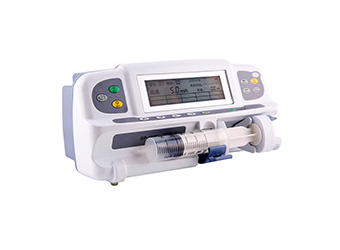
The medical syringe pump motor drive solution consists of a stepper motor and its driver, a lead screw and a bracket. Because it uses a reciprocating lead screw and nut, it is also known as a lead-screw pump. The nut is connected to the syringe plunger, and the syringe holds the medication, delivering fluid with high precision and smooth, pulsation-free flow. In operation, the stepper motor drives the lead screw to convert rotary motion into linear motion, pushing the syringe plunger to deliver the infusion and achieving high-precision, smooth, pulsation-free fluid transfer. The injection rate can be set by the operator from the keypad.
Solution Overview
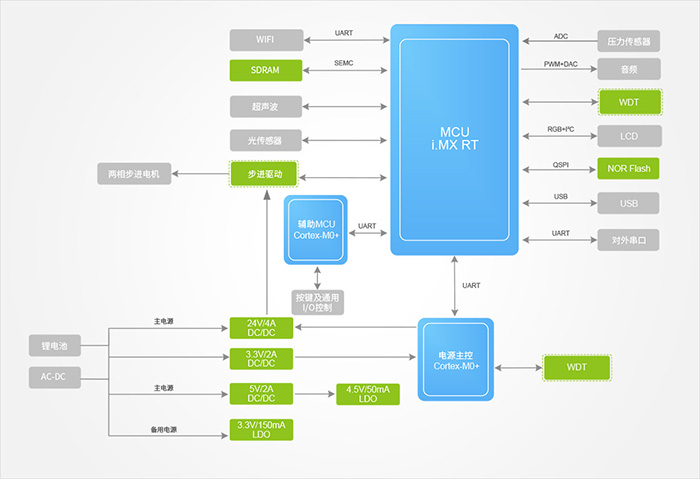
The medical syringe pump motor drive solution is based on the high-performance AMetal-Stepper stepper servo algorithm. The main processor is a Cortex®-M7 running at up to 600MHz, which executes the AMetal-Stepper algorithm, ultrasonic bubble detection and pressure/occlusion detection, together with human-machine interface functions such as audible alerts, LCD display and USB communication. The auxiliary MCU is a low-power processor based on the Arm® Cortex®-M0+, which effectively reduces power consumption in sleep-and-wait-for-wake-up mode. The power management main MCU is also based on the Arm® Cortex®-M0+ and handles overall system power control.
Recommended MCU
- i.MX RT series: i.MX RT1052: Arm® Cortex®-M7@600MHz, 512KB RAM; 8/16bit external memory controller interface (SEMC) for external SDRAM, Nor Flash and SRAM; dual-channel QSPI interface for external NOR Flash; 2 × USB-OTG interfaces; security: true random number generator (TRNG), AES-128 engine, bus encryption engine; 2 × 12-bit ADC and 4 analog comparators; quadrature decoder and FlexPWM modules; drives up to 4 sensorless FOC channels simultaneously
Core Components
- Cortex®-M7 processor: i.MX RT (NXP)
- Auxiliary MCU: NXP, full part number available on request
- Power management controller: NXP, full part number available on request
- Stepper driver: MPS, full part number available on request
Functional Block Diagram