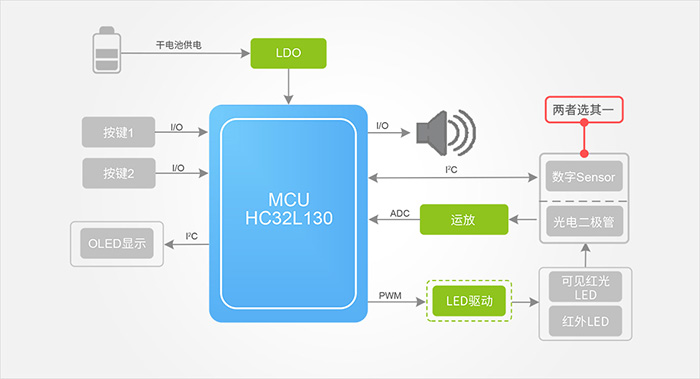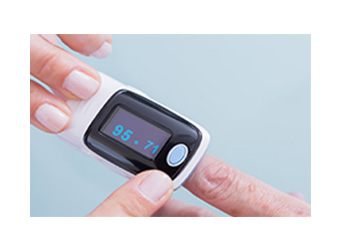
Our pulse oximeter solution offers two detection methods. One uses a photodiode to receive the light signal for traditional transmissive finger-clip measurement. The other uses a spectral sensor to receive the light signal for reflective measurement. The latter can take readings at multiple locations on the body, effectively avoiding restrictions on where the device can be used. It is widely applicable to medical devices, wearables, smartphones and similar products.
Solution Overview
In this solution, one detection method uses a photodiode to receive the light signal for traditional transmissive finger-clip measurement; the other uses a spectral sensor to receive the light signal for reflective measurement. The sensor converts the light signal directly into data and passes it to the main controller for processing, sparing the user the steps of converting the light signal into an analog signal and then into a digital signal, which further improves measurement accuracy and speed.
Recommended MCU
- HC32L130 series: 48MHz Cortex®-M0+ 32-bit CPU platform; flexible power management system with ultra-low-power performance; integrated 12-bit 1Msps high-precision SAR ADC plus a rich set of communication peripherals for excellent value; built-in security modules such as AES and TRNG, taking the balance of performance and power consumption and the level of advanced security to a new height
Core Components
- MCU: HC32L130 (HDSC)
- LDO: ZL6205 (ZLG Microelectronics)
- Sensor: AMS, full part number available on request
- Integrated op-amp: 3PEAK, full part number available on request
Key Advantages
- High accuracy
- High sensitivity
- Low power consumption
- Chinese-language development documentation
- Comprehensive technical support
Functional Block Diagram