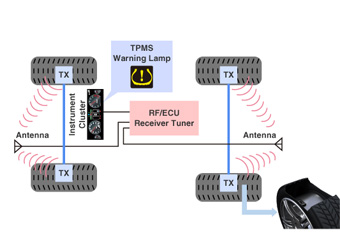
A Tire Pressure Monitoring System (TPMS) is an active vehicle safety system that uses wireless transmission technology. Highly sensitive miniature wireless sensor modules fitted inside the tires collect data such as tire pressure and temperature while the vehicle is moving or stationary, and transmit it to a receiver unit in the cabin, which displays the tire pressure, temperature and other related data digitally in real time. When a tire behaves abnormally (to prevent a blowout), the driver is warned by a buzzer, voice prompt or similar alert. This keeps tire pressure and temperature within the standard range, reducing the likelihood of blowouts and tire damage while lowering fuel consumption and wear on vehicle components.
Solution Overview
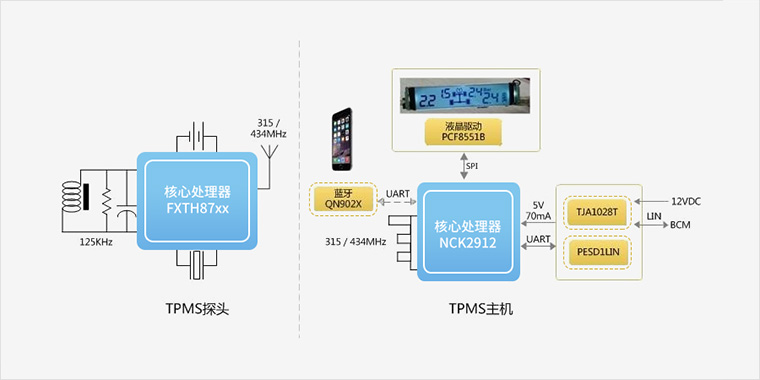
Our flagship TPMS solution is a complete system built on NXP devices. On the receiver/display side it suits both OEM and aftermarket requirements, and can alert the driver through a variety of display methods: for example, sending data over LIN or CAN to the instrument cluster or trip computer for display, pairing with an external display, or transmitting to a smartphone over Bluetooth.
Recommended MCU
- FXTH87EXX Series
- e.g. FXTH87E0911
- or FXTH87E0902
- NCK291X Series
- e.g. NCK2910 (no MCU)
- or NCK2912
- or NCK2913 (frequency hopping)
Core Components
- Automotive MCU: KEA Series (NXP)
- RF receiver: NCK2910/ NCK2912 (NXP)
- Sensor: FXTH8709 (NXP)
- LCD driver: PCF8551B (NXP)
- Bluetooth chip: QN902x (NXP)
- LIN: TJA1028T (NXP)
- ESD protection device: PESD1LIN (Nexperia)
Reference Design Kit part number: TPMS-LCD-Display Rev.B / TPMS receiver unit
- The single-chip receiver solution can be built in a very compact form factor for easy installation; with few external components, the receiver module is also less susceptible to outside interference
- For OEM applications, the RF functions of the TPMS and PEPS sections can be combined into an RF repeater, improving RF reception performance while reducing cost
- An intelligent polling mechanism substantially lowers power consumption while maintaining an extremely low bit error rate
- Average power consumption of the TPMS receiver unit in operation is as low as 700uA, making it fully suitable for solar-powered applications
Reference Design TPMS sensor module
- Integrates an 8-bit microcontroller (MCU), pressure/temperature sensor, X-axis + Z-axis or Z-axis accelerometer, and an RF transmitter
- Extremely low power consumption; the unique dual-axis accelerometer architecture enables the smallest possible module design, suitable for lightweight, space-constrained applications
- Flexible software development speeds up time to market
- Ultra-small QFN 7×7×2.2 mm package meets the needs of both external and internal mounting designs
Functional Block Diagram