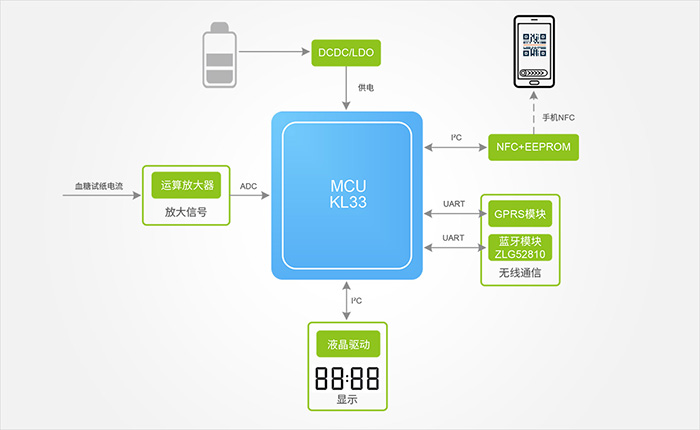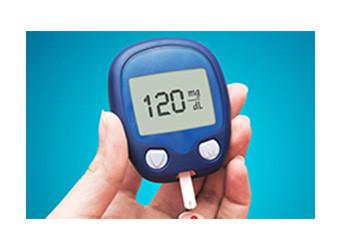
A blood glucose meter is an instrument that uses a test strip to carry a blood sample, analyzes it, obtains the blood glucose level, and then displays the result or transmits the data to a back-end system. In our blood glucose meter solution, an operational amplifier amplifies the micro-current generated by the test strip so that it can be sampled by the MCU. An LCD and a wireless module are added externally, allowing glucose readings to be uploaded to the cloud or to other devices, while an EEPROM stores the patient's historical glucose measurements for analysis and trend tracking.
Solution Overview
A high-precision operational amplifier amplifies the weak current signal generated by the test strip, and the amplified signal is sampled by the MCU's ADC. Because the blood glucose concentration is proportional to the weak current produced by the strip, the MCU can derive the glucose concentration from the amplified signal strength. Once calculated, the reading is shown on the LCD, or sent through the wireless module to a phone or the cloud for analysis and tracking. An EEPROM records recent glucose trends so that users can review and analyze the data locally.
Recommended MCU
- Kinetis L series: MKL33: low-power, high-performance 32-bit MCU; rich set of analog, communication, timing and control peripherals; adds an optional segment LCD controller; compatible with other Kinetis MCUs
Core Components
- MCU: MKL33 (NXP)
- LDO: ZL6205 (ZLG Microelectronics)
- Operational amplifier: 3PEAK, full part number available on request
- NFC chip: Fudan Micro, full part number available on request
Key Advantages
- High accuracy
- Portable
- Low power consumption, low cost
- Technical support at both chip and module level
Functional Block Diagram